Thứ Năm, 21 tháng 11, 2013

Hanoi's Traditional Dishes


Hanoi people are famous for the simple but subtle cuisine. As time goes by, the capital’s food is more and more affirmed its important position in Vietnamese culinary culture. Besides the variety, the cuisine of Hanoi still keeps its traditional feature.

The following introduce 10 simple and delicious dishes of Hanoi which are existed for a long time.


1. Pho - Hanoi Noodle


Pho

First thing to remember when talking about Hanoi is “Pho” or noodle soup. “Pho is a special gift ofHanoi, not just only in Hanoi, but because only in Hanoi that it is delicious”, Thach Lam wrote.

The traditional Pho of Hanoi is famous for the soft noodles, pure and sweet broth, the tender and flavor beef. There are many delicious booths of Pho in Hanoi, such as: Pho Suong - Dinh Liet St, Traditional Pho - Bat Dan St, Pho Thin - Lo Duc, Pho Cuong - Hang Muoi St…

2. Bun Cha (vermicelli with grilled meat)


Bun Cha


“Bun cha” (vermicelli with grilled meat) is known as a particular gift which Hanoi sent to all over the country. It is the delicious of the well-grilled meats and the sweet-and-sour sauce that grab every guest’s footstep. Bun cha in Dong Xuan market lane, 14 Hang Than st, 81alley Lac Long Quan st or pavement at the intersection of Nguyen Du and Ba Trieu st… is some good address for this dish.

3. Bun thang (vermicelli in chicken soup)


With nearly 20 ingredients, “bun thang” (vermicelli in chicken soup) is the dish that the cooking method requires the scrupulousness, care and sophistication of the cook, and also is one of the typical dishes containing innumerable quintessence of Hanoi’s culinary. 

Bun thang

Vermicelli is put in large bowls, ornamented on the surface with thin omelet, lean meat pie, chipped pork… then poured with hot consommé. Some recommended addresses: Hang Hanh st, Cau Go st, 11 Hang Hom st, 11 Ha Hoi st…

4. Cha ca La Vong (La Vong fried fish dish)

Cha ca La Vong
Read more about 4 saint temples protect Thang Long- Hanoi
“Cha ca La Vong” (La Vong fried fish dish) is the perfect combination of typical Vietnam’s spices such as: saffron, fennel, shrimp paste and fish sauce. All of those mix together into a unique, incredibly delicious and attractive dish. Cha ca La Vong is always in the list of foods that can’t be ignored by foreign visitors once coming to Hanoi. The famous restaurant is located at 14 Cha Ca st.

5. Banh Cuon Thanh Tri (rice rolls)

Banh cuon 


“Banh cuon Thanh Tri” (rice rolls) is a traditional dish which is made of rice-flour. It has the very thin and light roll covered by a yellow fried-onions layers, dipped in the tasty sauce with some roasted cinnamon porks (“cha que”). Nowadays, you can eat “banh cuon” in everywhere, but those made in Hanoi, especially “banh cuon Thanh Tri”, still have their specific characteristics.

6. Cha Ruoi


“Cha ruoi” is a scarce speciality of Hanoi, because the nereididae sandworm only can be found in a short season.
Cha ruoi

“Cha ruoi” which is crispy outside, soft inside, greasy and the delicious smell pervades all the guests is often sold at O Quan Chuong, in Lo Duc st and Gia Ngu st.

7. Banh Ran- (fried cake)

Banh ran


“Banh ran” (fried cake) is a popular cake in Hanoi, but “banh ran luc lac” or shaken fried cake is a traditional dish of Hanoi’s people. Its outer shell is made from glutinous rice flour, covered with roasted sesame. Especially, the filling made from sweetened mung bean paste is separated from the shell so that when you shake the ball cake, you can feel the rattled of it inside the shell. You can buy “banh ran luc lac” at 21 Le Dai Hanh st or 16A Ly Nam De st.

8. Bun Oc (Cold snail noodle)

Bun oc


Cold snail noodle (Cold snail noodle) is particular dish of Hanoi. It’s not easy to find the place where served this dish and not so many people can cook it well. Its consommé is a little sweet, fresh, sour and salty enough with the fragrant of ginger, the pungent of chili. You can find it at 202F Doi Can st or at O Quan Chuong.

9. Cha Nhai (frog omelette)


With Hanoi’s gourmets, “cha nhai” is a special food of Hanoi alone. 

Cha Nhai

The frog is chopped both meat and bones, crushed well, mixed with spices, chili, citronella, lime leaves… and deep fried in boiling oil pan. Then, we have a fragrant food that is a favorite dish of many people. The most delicious “cha nhai” is sold at Khuong Thuong st.

10. Com ( grilled green rice)


When the autumn wind comes is also the time that “Com” (grilled green rice) is appeared in many streets in Hanoi. 
Com

“Com” is made from green sticky rice that is harvested in blossom period, roasted in many times, crashed and sieved. When eating com, you must eat slowly and chew very deliberately in order to appreciate all the scents, tastes, and plasticity of the young rice. Com is used in many specialities ofVietnam, including com xao (browned com), banh com (com cakes), che com (sweetened com soups), etc. You can find “com” everywhere in Hanoi, but the most delicious “com” is processed in Vong Village, where com making has been a professional skill for many generations.

There are many tasty dishes you should enjoy when visiting Hanoi. Come here, and feel the soul of Hanoi’ cuisine!


Thứ Ba, 19 tháng 11, 2013

Salted or Sugared Dry Fruits – A Specialty of Hanoi


Salted or sugared dry fruits

1. A specialty of Hanoi 

Ô mai” (Salted or sugared dry fruits) has always been recognized as a famous Vietnamese snack. It is favored by a lot of Vietnamese people, especially women. It is a perfect combination of the sour taste of apricot, the saltiness of sour, the spicy of ginger and the natural sweetness of liquorices. “Ô mai” is always used during Tết Holiday (aka Lunar New Year) and is a favorite gift for Vietabroaders. “Ô mai” has a lot of flavors to serve your preference. 

Maybe, no where in the world can find the special nosh more delicious than in Capital city of Hanoi, Vietnam with “O mai”. For the past years, “o mai”, salted or sugared dry fruits, was a favorite not particularly with Hanoian. Time is passing through and this speciality is now becoming a popular snack and an expected gift for all Vietnamese people, Vietnamese oversea also.


Salted or sugared dry fruits
The oldest and most famous type of “Ô mai” ever known may be apricots, following dracontomelum, star, tamarind, kumquat, pineaple, canari, lemon, mango. As increasing demand and different taste of customer, o mai makers are now adding more fruits from all regions to adapt from traditional recipe.

2. Where to buy salted or sugared dry fruits in Hanoi.


Salted or sugared dry fruits

Read more about 5 Places to celebrate Christmas night  in Hanoi


The variation of flavor of O mai from sour, hot, salted, to sweet has enchanted many visitors to Hanoi. Nowadays, coming to Hanoi, after a visit to Hanoi Old Quarter, you should get the Hàng Đường (Hang Duong) or Hang Ngang, Pho Hue where the most delicious and wonderful ô mai are sold. Interestingly, at these shop, you can feel free to tast all kind of o mai before paying for the most favorite. Ô mai is a delicious affordable gift for your friends each time you came to Hanoi.


Source: Vietwindtravel

Thứ Sáu, 15 tháng 11, 2013

Tips for Crossing Streets in Vietnam


Tips for Crossing Streets in Vietnam


Most visitors have a love-hate relationship with the traffic in Vietnam. They hate it for being messy, scary and are even perceived as dangerous. But most, if not all, will tell you that crossing the Vietnam streets is one of the best experiences during their Vietnam travel. Vietnam drivers and riders depend a lot on the body language as a guide. So the trick really is not to have any sudden movements when crossing a road in Vietnam.

Tips for Crossing Streets in Vietnam


Here are tips for you when crossing streets in Vietnam.
  • Be relaxed and self-confident.
  •  Look two ways or make eye contact with drivers.
  • Walk slowly with purpose.
  • If it’s 2-way traffic, look right, left and then right again at the half way mark.
  •  Put your arm in the air. It makes you more visible to traffic and is an added precaution. Hopefully the arm will indicate to the motorists that you are in fact crossing the street and to look out for you.
  • Don’t run across the road, it shows fear and you’re more likely to get mowed down.
  •  Commit yourself. Though every instinct in your body is screaming for you to stop, turn around and head back, don’t. Turning back can be more dangerous than continuing on.
  • There’s always safety in numbers. The same applies when in Vietnam. You’re much more likely to be seen by a motorist when walking with a group than venturing across the street solo. Traveling alone? Don’t feel bad being that creeper who silently stalks along next to a family crossing the street. Better safe than dead.
  •  Standing in the middle of the road and trying to take a photo is never a good idea
  • Enlist the help of a local. Vietnamese people are very friendly and most are more than happy to help you cross the road


Useful Words and Phrases When Traveling Vietnam


Traveling to a foreign land is quite interesting and exciting because for many people who like to travel, go on a vacation or even take a holiday trip, they need to do a lot of preparation before setting off, like learning about the country’s rich culture and knowing the basics of their language.


Useful tips and phrases when travelling Vietnam

Learning the language of the country that you plan to visit can be challenging but exciting at the same time, because not all languages have the same grammar and construction. Also knowing the language adds a twist to your vacation because it will help you to make your way around the city easier. Most of the locals appreciate tourists who try to converse and communicate in their local tongue because they feel that you appreciate their customs and culture and most of all, their country

Here is a list of words that we think would be useful to know while traveling in Vietnam. We are not going to bother to include the accent marks because it’s doubtful that non-native speakers will be able to say any of the words correctly anyways. Just try to memorize what the words look like or write them down on flash cards that you can refer to when out and about…


Useful Words and phrases when travelling Vietnam
Vietnamese is so hard because it is a 6 tonal language….and even the slightest variation of the pronunciation changes the meaning of the word(s).  This is not even taking into consideration the many different dialects that can be found throughout the country.  For example, the people in North Vietnam (Nguoi Bac)  speak completely different than in the South (Nguoi Nam).  Then there are the other variations of people that live in the Central Vietnam (Nguoi Trung and Nguoi Hue). 
-          Mien Phi (Mee-in Fee) – Free…..usually used in conjunction with “wifi” when in a hotel or coffee shop.
-          Sieu Thi (Seal Tee)- Supermarket
-          Nuoc Ep (Nook Ep) – Fruit juice – extracted by squeezing or blending fresh fruit
-          Trai Cay (Try Kay) – Fruit
-          Di Dong (Yi Dong)- Cell Phone Service (i.e. Mobifone, Vinaphone, etc.)
-          Han Quoc (Hang Wook) – Korea or Korean
-          Trung Quoc (Troong Wook) – China or Chinese
-          Quoc Te (Wook Teh) – International
-          Cafe Sua Da (Ka Feh Sooahh Daa)- Vietnamese Iced Coffee
-          Xe Om (Seah Um) – Motorbike Taxi
-          May vi tinh (May Vee Thin) – Computer
-          Nha Ve Sinh (WC) (Nyah Veh Sin)- Restroom……W.C. stands for Water Closet and is apparently a legacy of the French occupation of Vietnam.
-          Cong An or Canh Sat (Kong Anhg or Khan Sak) – Police
-          Benh Vien (Ben Vee-in) – Hospital
-          Cong Ty (Kong Tee) – Company
-          Nha or Phong Cho Thue (Nyah or Fong Jaw Tweh) – House or Room for rent
-          An Chay (Ang Chey) – Vegetarian
-          Thuoc Tay (Te-ook Thay) – Pharmacy
-          The Gioi (Te Yoi?)- The World
-          Kem (Kam) – Ice Cream
-          Gui Xe (Goi? Seah) – Park Car
-          Xe Honda (Seah Honda) – term used to refer to all kinds or motorbikes
-          Khach (Cat) – Guest…this word can be combined with others as shown below
-          Khach Du Lich (Cat Yoo Lit) – Tourist
-          Khach San (Cat Sang) – Hotel
-          Cap Cuu (Cap Koo?) – Emergency….should pronounce the last part as if asking a question.

Vietnam Travel Tips


By Tom Hewitson

Like most things in life, the more you put in, the more you get out - and in Vietnam just a little preparation will set you up for the trip of a lifetime. For the newcomers, here is some tips when travelling Vietnam.

                                                         Vietnam travel tips

1. Keep smiling

Despite the grumbles of many visitors, Vietnamese people are mostly just as friendly as their Southeast Asian counterparts. However, unlike in Thailand, Cambodia and Laos - where local residents are genuinely curious about who you are and where you’ve come from - Vietnamese people tend to ignore lost-looking foreigners unless you actually ask for help. But be assured that if you ask a local a question with a smile, you'll almost certainly have it answered and the smile returned.

Vietnam travel tips

2. Be wary of taxi scams

For many, motorcycle taxis are the only way to truly see the thronging streets of Hanoi and Ho Chi Minh. However, although unlikely, scams can happen and your best protection is a decent knowledge of where you are going and points along the way. If you think you’re going the wrong way, simply tell your driver to pull over and flag down a new bike - those that stop should at least know the English names of the main tourist sights. Also, organise for a hotel pick-up from the airport - scam taxis are rife and, as my quickly lightened wallet can attest, far more expensive and stressful than the $5 you supposedly could save.


3. Know your night buses


Overnight buses are a great way to cover long distances and save on accommodation costs, but make sure you book a top bunk as far as possible from the loo (normally situated near the back). Not to put too fine a point on it, a lot of buses don't have working bathrooms and the further back you are, the worse the smell gets. Also, unless you have an iron bladder, don't drink more than absolutely necessary, as rest stops seem to be purely at the whim of the driver and are skipped completely if the bus is running late. On one seven-hour bus trip - that ended up being a 16-hour voyage - I was very glad to have followed this tip. Not all of the other passengers had done so - enough said!

4. Avoid nightlife trouble


                                                           Vietnam travel tips

Vietnam has possibly the cheapest beer in the world but it pays not to overdo it. In Hanoi there is an official curfew on bars and nightclubs, which the police may turn up and enforce unless the owner has paid a suitable 'fee'. Hiding in the dark as the club pretends to be closed while a police car drives by can be amusing, but it sucks when half your group gets thrown out by the cops and can’t get back in. Meanwhile, Nha Trang leaves a sorry trail of wallet-lightened backpackers who experienced the not-uncommon misfortune of running into pickpocketing prostitutes - and attendant gangs - on their way home after a night out.

5. Motorcycle safely


                                                           Vietnam travel tips

Clarkson may have done it, but he had a whole production crew and still ended up with a couple of broken ribs. Vietnam is not the place to learn to ride a motorbike. I have rarely been as scared as the moment I had to cross a traffic-light-free four-lane junction where scooters dodged each other by mere inches. The roads are truly terrifying and unfortunately the stories of tourists killed attempting a two-wheeled adventure are all too based in fact.
If you're determined to get the thrill of a bike, it's worth looking into the Dalat Easy Rider (dalat-easyrider.com) where an experienced Vietnamese rider will take care of the driving so you can sit back and enjoy the scenery.

6. Be bold
Vietnam travel tips

Most important of all: don't be scared. Vietnam can seem intimidating and overwhelming at first, but keep a sense of humour and everything will work out fine. Just like the streets of Hanoi, where to cross the road you have to wade out into moving traffic whispering prayers to any and every god that you won't get hit, the worst thing you can do is freeze. Keep moving at a steady pace and the bedlam will slowly envelop and glide around you - until magically you are right where you wanted to be without a single scratch!


Thứ Năm, 14 tháng 11, 2013

Terraced Field Farming in Northern Vietnam

1. Terraced Field  in Northern Vietnam where Heaven meets Earth


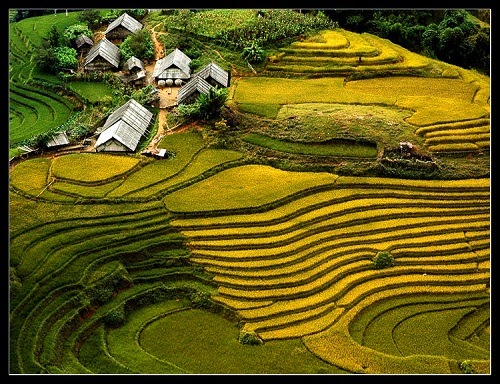
Northwest Vietnam is greeting autumn with a glamorous view of golden crops on the terraced fields at the foot of the impressive Mount Fansipan. Terraced fields, which look like “ladders to the sky” from the mountainous villages are always wonderful attractions for foreign tourists. The fields, created by talented and diligent ethnic farmers, have remained there for hundreds of years.


Terraced field in northern Vietnam


Terrace farming is the way that people adapt to their environment. Think of a steep-sloping hillside. If this is the only land you have to grow crops on, how do you then grow crops without everything sliding down the hillside? Since ancient times, mountainous farmers have built terraces to shore up a hillside, creating several levels of farms. In a small, seemingly inhospitable place, they can grow the crops they need to grow to survive.


Instead of flowing freely down the hillside, water stops on the level plain. In this way, the lower terraces are not eroded and, also, the higher terraces get enough water. On a straight, steep slope, water would tumble down the hillside, carrying crops and much-needed soil with it, letting nothing grow. But add the element of a terrace, and you have flat areas on which to farm.

Terraced field in northern Vietnam


A terraced field has many levels in series and each level is a small field. The more levels there are, the more farming techniques the owner has. Given the scarcity of flat land, wet rice growers use hillsides to create an even and flat plot of land which looks like a three-step staircase. That’s the way terraced fields were created, a rare feature of Vietnam’s wet rice civilization. Giang A Pua of the Mong ethnic group in Ha Giang province told us about how he chooses the land for growing rice: “The hardest work is land reclamation. The field location should not be very sloppy with less gravel. A good place is where there is thick grass or big trees”.

2. The Terraced Field farming Methods


The history of terraced fields is associated with the history of residence of ethnic groups in Vietnam’s northern mountains. Their cultural values are reflected in the farming experience, production customs, the formation of terraced fields of each ethnic group. One of the most prominent examples is in the rice field of Southeast Asia. Acre after acre of what looks like unusable land contains terrace after terrace. Much of the rice that comes from Vietnam, Thailand, and other Southeast Asian countries is grown on terraces. Rice, especially, needs a lot of water to grow. The more flat areas existing on which to grow rice, the more rice people can grow. And with the terrace farming idea, water stays on the level surfaces, so rice grows in places that, on first glance, wouldn't necessarily look to be good farmland.


Ethnic people in Northern Vietnam 


After a place is chosen, the improvement of soil is very important. The first step is to dig a ditch to supply water to the newly-exploited field. Luong Van Thiet of the Vietnam Museum of Ethnology explains that the digging is undertaken by men, who must be skillful enough to make water flow constantly into the rice fields, particularly during the transplanting of rice seedlings. The water flows from the upper levels down and each piece of field is part of this irrigation system. If the terraced field is owned by many households, the management and distribution of water is shared between them

The land exploitation and rice cultivation has been maintained from generation to generation over hundreds of years. Each terraced field creates a beautiful picture on the hillside.

Together with the formation of terraced fields and the sedentary farming, ethnic groups the northern mountains have adopted many traditional festivals and cultural activities associated with agricultural production. Thao Thu Do of the Mong ethnic group in La Ban Tan commune, Mu Cang Chai district, Ha Giang province, told “The Mong people consider a terraced field an invaluable basket of rice. The field is most beautiful when the paddies turn yellow. When there are abundant rice, we feel very happy”. During the harvest time in October, the gold rice field stands out of green forests, creating a magnificent picture in Vietnam’s northern part.


Source: Vietwindtravel
Expat in Hanoi